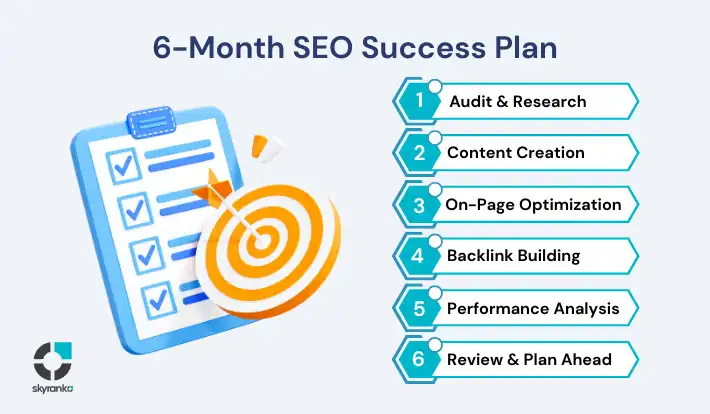
A 6 month SEO plan is a roadmap that gives each month one job: audit, map, build, earn authority, refine, then review. Six months is the shortest window where I’m comfortable setting growth targets with a client, because it covers both the quick fixes and the slower work of content and links getting picked up. The month order stays the same for every site. What changes is the weight: an online store spends more of it on category pages, a SaaS site on comparison pages, a blog on topic clusters.
Short on time? The 3 month SEO plan is the week-by-week sprint version.
Why Is Six Months the Right Length?
Three months fixes foundations. That’s about it. New pages often need weeks just to settle in the results, and links take longer still to show any effect, so a 90-day window usually ends right before the interesting part starts. Twelve months is better, but honestly, most owners won’t fund a year of work without proof.
Six months sits in between. The best result I can point to at Skyranko is a client who saw 700% more organic traffic in 4 months from a keyword, content and link campaign.
Is that normal? No. I quote it because it shows what focused work does when the foundation is already clean.
Which Kind of Site Are You Running?
Before Month 1, answer one question. It decides where every hour goes.
- Ecommerce store: revenue comes from category and product pages, so technical health and product content lead.
- SaaS product: revenue comes from demo and trial signups, so comparison, alternative and use-case pages lead.
- Blog or publisher: revenue comes from ads or affiliates, so topical depth and publishing volume lead.
- Local service business: revenue comes from calls, so Google Business Profile, reviews and service pages lead.
If you are a mix, pick the model that makes the most money today. I’ve watched plans that try to serve all four at once end up doing none of them well, because the budget gets sliced so thin that no single page type ever gets finished.
The Month-by-Month 6 Month SEO Plan
Month 1: Audit and Baseline
Set up Google Search Console and Google Analytics 4, then record your baseline: organic clicks, impressions, top pages, conversions and indexed page count. Write it down. You’ll need it in Month 6.
Next, crawl the site with Screaming Frog or Sitebulb and fix the blockers: stray noindex tags, broken internal links, redirect chains, duplicate titles and bloated templates. None of it is glamorous, yet every other month depends on it.
Check Core Web Vitals in PageSpeed Insights against the current thresholds: LCP under 2.5 seconds, INP under 200 milliseconds, CLS under 0.1. INP replaced FID in March 2024, so any template still asking you to improve FID is stale.
Month 2: Keyword Research and Site Architecture
Build a keyword list segmented by intent: informational, commercial and transactional. For most small sites, 20 to 40 targets is plenty. Long-tail phrases tend to convert better and face weaker competition, which is why I weight them heavily early on.
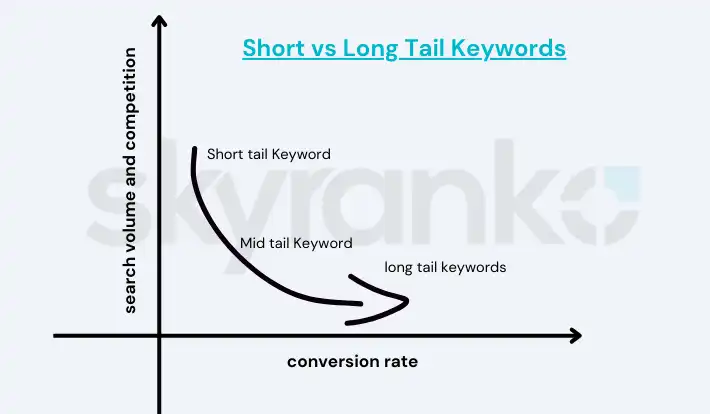
Then assign every keyword to exactly one URL and sketch the hub-and-spoke structure. A topical map is the cleanest way I know to do this. It also stops two of your articles from fighting over one query later.
Month 3: On-Page Work and the First Content Wave
Rewrite titles and meta descriptions wherever Search Console already shows impressions. Fix heading structure, compress images, add alt text. Then publish the first wave of new content from your map, and link each fresh URL from at least two related older ones on the day it goes live.
Depth beats count. After its March 2024 core update, Google reported 45% less low-quality, unoriginal content in search results, and thin filler posts were exactly what got cut. Four pages that show real expertise will outperform twenty that don’t.
Month 4: Authority and Link Building
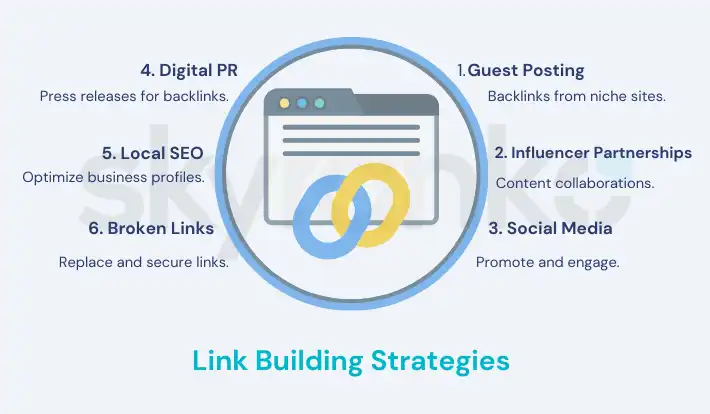
Now you have pages worth citing. Go earn links. The tactics that still work: guest posts on relevant sites with real traffic, digital PR around original data, broken link building, partner and supplier mentions, and real business listings. Spread them over several weeks instead of dumping them in one go; our guide to drip feed link building explains the pacing.
Here is where I part ways with the old version of this post. Forum link drops, social bookmarking, PDF submission sites and “edu/gov link packages” are not a plan. Google’s spam policies treat manipulative links as link spam, and cleaning up after them costs more than building them.
Month 5: Measure, Refresh and Fix the Leaks

Compare Search Console data against the Month 1 baseline. Pages with high impressions and weak click-through need sharper titles. Pages stuck at positions 8 to 20 need more depth, more internal links, or both.
This is also refresh month, and my content refresh strategy shows how I decide which pages to update, merge, prune or leave alone. Update older articles with new data, merge thin posts that overlap, and repair pages where visitors land and leave without converting. When I review a site at this stage, the fastest gains nearly always come from URLs that already exist, not from anything new.
Month 6: Review and Plan the Next Six Months

Pull the full six-month comparison: clicks, impressions, keywords on page one, conversions and revenue from organic traffic. Then sort your pages into winners, climbers and dead weight. Winners get supporting content, climbers get links, dead weight gets merged or rewritten.
Use that sort to write the next half-year. A 12-month SEO plan is simply this plan run twice. The second half just gets built on evidence instead of assumptions.
How the Plan Changes for Ecommerce Sites

If you run a store, shift weight into Months 1 and 3. Faceted navigation, duplicate product variants and out-of-stock pages quietly burn crawl budget, so fix those before you publish anything.
My take: category pages usually carry more commercial keywords than individual products. I optimize them first.
Add Product structured data so Google can show price, availability and ratings in results. Our guide to product page SEO covers the page-level work. The blog can wait until Month 4, unless buying guides are an obvious gap.
How the Plan Changes for SaaS Sites

SaaS buyers search in stages, from “how to fix X” to “best X tool” and “X vs Y”. If your product is a SaaS, Month 3 content should start at the bottom of that funnel: comparison, alternative and use-case pages. Those convert. Awareness guides come later.
In my experience, SaaS companies also sit on the best link-earning assets anyone has: templates, calculators, anonymized usage data. Build one in Month 4. It will outlast a dozen guest posts.
How the Plan Changes for Blogs

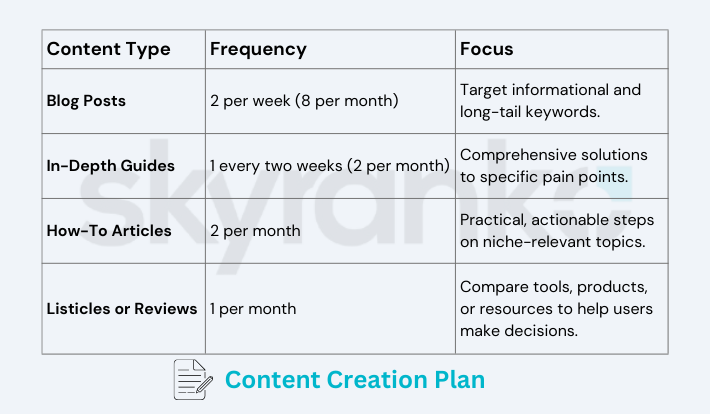
Blogs live and die on topical depth. For a blog, Month 2 becomes the most important month, because your cluster map decides every post you write afterwards. Pillars first, then the supporting posts that link back up.
The schedule below is aggressive. I’d only suggest it when you have a writing team. A solo blogger should halve it and hold the quality bar, because 13 rushed posts a month will hurt more than 6 careful ones.
What About Local Service Businesses?
Local sites pull Google Business Profile work into Month 1: correct categories, service areas, photos and a steady review request process. Month 3 content becomes service pages plus one strong page per real location.
Month 4 links come from local partners, sponsorships, chambers of commerce and genuine directories. If you’d rather hand it off, that’s the work our local SEO service covers.
Your 6 Month SEO Plan Template
Copy this table into a spreadsheet and add a column for your own targets. Everything above fits into these six rows.

| Month | Main job | Key actions | Deliverable |
|---|---|---|---|
| 1 | Audit and baseline | GSC and GA4 setup, crawl, Core Web Vitals, fix blockers | Baseline report and technical fix list |
| 2 | Keywords and architecture | Intent-based keyword list, keyword-to-URL map, topical map | Keyword map and content calendar |
| 3 | On-page and first content | Title and meta rewrites, internal links, first content wave | Optimized pages and new pages live |
| 4 | Authority | Guest posts, digital PR, broken links, real listings | Link report with every URL |
| 5 | Measure and refresh | CTR fixes, content refreshes, merges | Refresh log and mid-point report |
| 6 | Review and plan | Six-month comparison, page sorting | Results report and next 6-month plan |
Which Metrics Prove the Plan Is Working?
- Impressions rise first. They show Google is testing your pages.
- Average position for mapped keywords should trend up by Month 4.
- Clicks and CTR follow once pages reach page one.
- Conversions from organic traffic are the number your boss or client cares about.
- Indexed pages should match the pages you want indexed, no more and no less.
Bounce rate isn’t in that list on purpose. In GA4 it is simply the inverse of engagement rate, and on its own it tells you very little about SEO.
When Should You Hand the Plan to a Specialist?
Bring in help for a site migration, a manual action, a hacked site or a large ecommerce catalog with crawl problems. Those need someone who has fixed them before, and for a WordPress site that bounces visitors to spam, my guide to removing a hacked redirect explains why the owner often can’t even see it. If you want a team to run all six months, our complete SEO service starts with the same free audit that opens Month 1.
Frequently Asked Questions
Is There a 6 Month SEO Plan PDF I Can Download?
Not as a separate file, but the template table above is the full plan in one place. Copy it into Google Sheets or Excel, add a column for owner and due date, and you have a working roadmap. I prefer a live sheet over a PDF anyway, because you’ll update it every month.
How Much Traffic Growth Should I Expect From a 6 Month SEO Strategy?
It depends on where you start. A site with technical blockers can see a big jump just from fixing them, while a clean site in a hard niche grows slower. Set your targets against your own Month 1 baseline rather than an industry average, and judge Month 6 on conversions, not only traffic.
What Is the Difference Between a Monthly SEO Plan and a 6 Month Plan?
A monthly SEO plan is the task list for one month. A 6 month SEO plan is the sequence of those monthly lists, where each month builds on the one before. Without the six-month view, monthly work tends to become random tasks with no clear order.
Can I Run a 6 Month SEO Plan Myself?
Yes, if you can give it roughly 5 to 10 hours a week and you’re comfortable in Search Console. That’s my honest estimate for a small site. The free tools cover most of it. Where DIY plans usually stall is Month 4, because earning quality links takes outreach time most owners don’t have.
Last updated: September 2026 by Mizanur Rahman