Yes, backlinks still work in 2026. They are still one of the signals Google uses to judge which pages deserve to rank, and Google’s own ranking systems guide still lists link analysis and PageRank among its core systems. But they are no longer the lever they were in 2012.
A handful of relevant links from real sites now does more than a thousand weak ones, content quality decides more than link count, and links you pay for or automate are likely to be ignored. So the honest answer to “do backlinks still work” is: yes, when four conditions line up.
What Has Google Actually Said About Links?
Let’s start with the source, because the rumors go both ways. At Pubcon Pro in September 2023, Google’s Gary Illyes said this about links as a top-three factor: “I don’t agree that it’s the top 3 and it hasn’t been for some time” (Search Engine Roundtable). In the same session he said content is the top signal and that a page can rank with no links at all.
That quote got shared as “links are dead”. It isn’t what he said. Not top three still leaves links in the mix, and Google’s ranking systems guide says it has “various systems that understand how pages link to each other” to work out what pages are about and which are most helpful.
John Mueller added the other half back in 2021. He said one really good link, say from a major news site, can be “a really important sign” for Google.
In the same hangout he said “the total number essentially is completely irrelevant” (Search Engine Journal). Put together, the message is consistent. Links matter. Link counts don’t.
Are Backlinks Still Important? What the Data Shows
Google’s comments are one input. I also want to see what happens to real sites. The most useful study I know on this is Semrush’s look at new domains, published in March 2023. It tracked 28,000 domains that first appeared in its US database after July 2021 and followed them for 13 months.
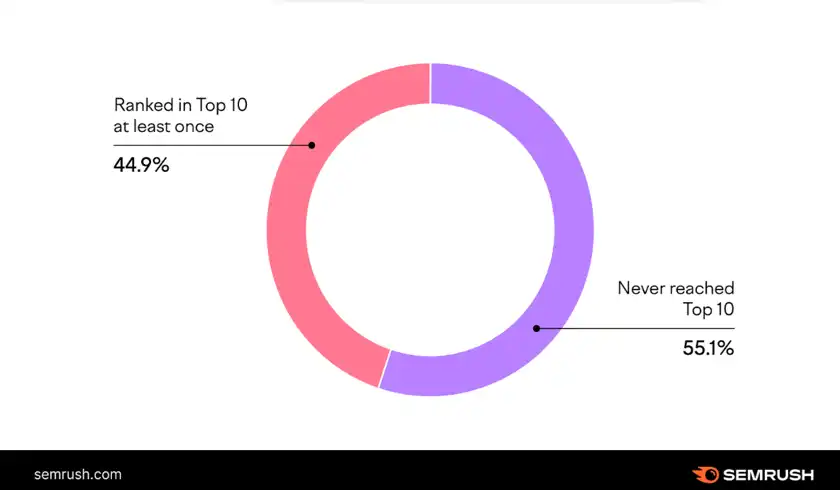
The first finding is the one I quote to clients most often. 55.1% of the domains that failed to reach the top 10 had no backlinks at all. Great content on a site nobody links to struggles in competitive results.
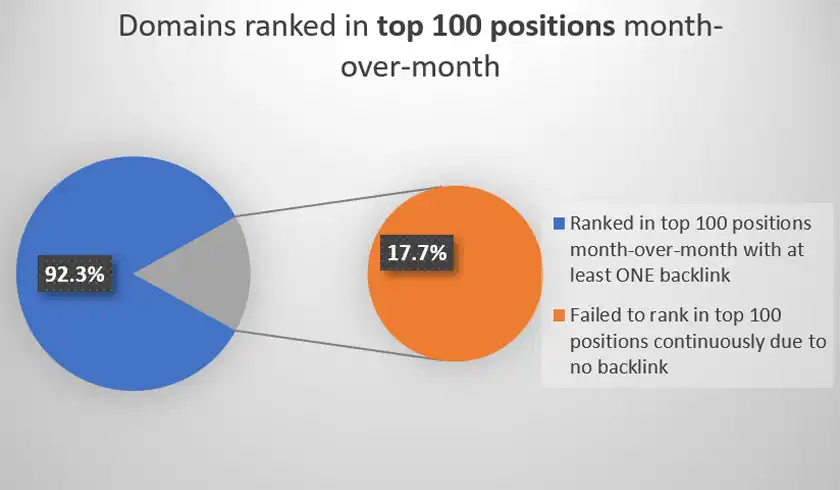
The second is about staying power. 92.3% of the domains that ranked in the top 100 for all 13 months had at least one backlink. That doesn’t prove links caused the rankings. It does show that sites without any links rarely hold positions.

The third finding compares winners with everyone else. The top 10% of domains finished the year with an average domain authority of 20.3 (Semrush’s metric), while the average for the qualifying group stayed under 10. The top performers also kept growing their number of referring domains month after month, while the average site’s count barely moved. Steady, not sudden.
Four Things That Decide Whether Links Will Work for You
In my experience, “do backlinks still work” is the wrong question. The useful one is whether they’ll work for your site, on your keywords, right now. Four variables change the answer:
- Competition on the query. Low-competition long-tail terms often rank on content alone. Commercial terms with strong incumbents almost never do.
- Relevance of the linking site. A link from a site in your industry, read by your buyers, counts. A link from a random general blog mostly doesn’t.
- How the link was obtained. Earned, editorial, or honestly labeled links are fine. Paid dofollow links, link exchanges and automated links are spam under Google’s policies.
- The page receiving the link. A link can’t rescue a page that doesn’t answer the search. It amplifies a good page.
Where Do Backlinks Still Work Best?
If your page is already good and sits on page two for a competitive term, then relevant links are usually the missing piece. That is the most common situation I see when I audit a small business site. The content matches intent, the technical basics are fine, and the top five results simply have far more referring domains from their own industry.
The same goes for new domains in established markets. The Semrush data backs this up: sites with zero links rarely break into the top 10. For a new ecommerce store or a local service business entering a crowded city, a few solid citations, local press mentions and industry links usually do more in the first six months than another twenty blog posts.
Links also help new pages get found and understood. A link from a relevant article tells Google what your page is about in someone else’s words. That’s the part of PageRank that has never really gone away.
When Won’t More Backlinks Help?
If your page doesn’t satisfy the search, then links won’t fix it. I’ve seen sites buy dozens of guest posts pointing at a thin service page and get nothing, because the pages ranking above it were simply better answers.
Skip link building for now if any of these sound familiar. Your keyword has low competition and the top results are forum threads. Your page has technical problems, such as being blocked, slow, or duplicated.
Or your site already carries a pile of paid or spammy links from a previous vendor. In the first case, content wins. In the second, fix the technical issues first. In the third, clean up before you add anything new, because more of the same pattern won’t help, and judge that cleanup by who built the links rather than by a tool’s red flags, as I explain in my take on toxic backlinks.
Is Backlinking Still Important for AI Search?
Here’s where 2026 is different. AI Overviews, AI Mode and ChatGPT all mention brands in their answers, and the signals behind that look a bit different from classic rankings.
Ahrefs studied 75,000 brands in 2025 to see what correlated with being mentioned in Google’s AI Overviews. Branded web mentions had a 0.664 correlation, while the raw number of backlinks came in at 0.218 and referring domains at 0.295. Correlation isn’t cause, but the gap is large.
My take: links still feed the classic rankings that AI answers often draw from, but being talked about matters more than being linked. A mention of your brand in an industry roundup, a podcast show notes page or a local news story helps you in both places, with or without the link. I separate what Google has actually said on the record from what people infer in backlinks vs brand mentions.
Which Backlinks Are Worth Earning Now?
These are the link types I’d prioritize for a small business or a content site today:
- Editorial links from articles that cite your data, guide or tool because it helps their readers.
- Expert quotes in journalist requests and trade publications, which often come with a byline link.
- Genuine contributor articles on niche sites with real readers, written to teach, with a brand or natural anchor.
- Local links from chambers of commerce, associations, sponsors and local news for location-based businesses.
- Foundation listings such as brand profiles and relevant business directories, which won’t move rankings alone but make your brand look established. I break down which ones still count in foundation backlinks.
If you’d rather have help with the contributor side, our guest post service places articles on real niche sites with 50+ referring domains and no PBNs. Ask us, or anyone else, how each placement is labeled before you pay. And if you want to pace links over months rather than in one burst, read my guide to drip feed link building.
How I Check Whether Links Are Holding a Page Back
When a client asks me “do backlinks still work for us?”, I don’t answer in general. I pick one page and run a quick check that takes about 20 minutes.
First, I open Google Search Console and find the queries where that page sits between positions 8 and 20. Those are the terms where links could plausibly make a difference. If the page ranks nowhere at all, the problem is almost always content or indexing, and I stop there.
Second, I put the top five results for the main query into Ahrefs or Semrush and count their referring domains, then look at who those domains actually are, ignoring raw backlink totals because one sitewide link can inflate them, as I show in backlinks vs referring domains. If the pages above you have 40 relevant referring domains each and yours has three, links are very likely part of the gap. If they have a similar count to yours, links aren’t what’s holding you back, and I’d look at intent, depth and page experience instead.
Third, I read the top results side by side with the client’s page. Honestly, this step catches more problems than any tool. Sometimes the page that ranks first has fewer links but answers the question in the first paragraph, with a price, a photo and a clear next step.
Edge Cases That Change the Answer
- Local businesses. For map results, proximity, relevance and your Google Business Profile carry more weight than links, though local links and citations still support popularity, the factor Google’s help page still heads as prominence.
- Health, finance and legal topics. Links from recognized institutions help, but visible expertise and trust signals on the page matter just as much.
- Brand searches. You’ll rank for your own name with very few links. Don’t read that as proof links don’t matter for anything else.
- AI answers. A brand can be cited in AI Overviews from mentions alone, so a strong PR mention without a link still has value.
What Stopped Working?
A lot of 2015-era link building now does nothing, or worse. Google’s spam policies call out buying links that pass ranking credit, excessive link exchanges, links made with automated programs, keyword-stuffed anchors in guest posts, and low-quality directory links.
Since the December 2022 link spam update, Google uses SpamBrain to neutralize unnatural links. In practice that usually means the links simply stop counting. No penalty letter, just money that bought nothing.
Nofollow links are a partial exception. Since 2019 Google has treated nofollow, sponsored and ugc as hints rather than strict rules, so a nofollow mention from a strong site isn’t worthless. I just wouldn’t build a strategy on them.
Should You Invest in Backlinks Right Now?
| If your situation is | And your content is | Then |
|---|---|---|
| Competitive commercial keyword, page two | Strong and matches intent | Invest in relevant links to that page |
| Low-competition long-tail keyword | Strong | Skip links for now, publish and interlink |
| Any keyword | Thin or off-intent | Fix the content first, links won’t save it |
| New domain in a crowded market | Decent | Foundation listings plus a few editorial links a month |
| Old domain with paid or spammy links | Any | Audit and clean up before adding anything |
When to Bring In Help
If you’re seeing a manual action for unnatural links in Search Console, or traffic dropped right after a spam update and you know a past vendor bought links, that’s a job for someone who does link audits and recovery. It isn’t a job for more link building. If you just want a clear plan, our SEO service starts with a free audit that checks your link profile against your real competitors.
Frequently Asked Questions
Do Backlinks Still Work for a Brand New Website?
Yes, more than for most. In Semrush’s study of 28,000 new domains, 55.1% of those that never reached the top 10 had no backlinks. A new site doesn’t need hundreds, but a few relevant links from real sites make a clear difference in competitive searches.
Are Backlinks Still Relevant If My Content Is Great?
Great content is the price of entry, and Google’s Gary Illyes has said content is the top signal. But on competitive queries, several pages usually have great content. Links are often what separates them, so content and links work best together.
Can Bad Backlinks Hurt My Rankings?
Usually Google just ignores them. SpamBrain has neutralized unnatural links since the December 2022 update. The real risk is a manual action if you built or bought them on purpose, which is why I’d clean up past paid links rather than hope they’re ignored.
Do Nofollow Backlinks Still Help SEO?
A little, sometimes. Since 2019 Google treats nofollow as a hint, not a hard block. The bigger value is usually referral traffic and brand visibility, which also help with AI search mentions.
Last updated: September 2026 by Mizanur Rahman